
Paper products are expected to withstand handling, converting, transportation, printing, and end-use without premature tearing. Whether manufacturing packaging paper, specialty papers, labels, tissue products, or industrial paperboard, understanding ASTM D689 is essential for evaluating the 종이의 인열 저항 and ensuring consistent product quality.
Using the widely recognized 엘멘도르프 방법, ASTM D689 determines the force required to propagate an existing tear through paper after an initial cut has been introduced. The method provides manufacturers, laboratories, and quality control professionals with repeatable data for material comparison, product development, supplier qualification, and process optimization.
This guide explains the fundamentals of ASTM D689, how the Elmendorf tear test works, applicable materials, interpretation of results, testing equipment selection, and practical applications across multiple industries.
What Is ASTM D689?
ASTM D689 is a standard test method used to determine the tearing resistance of paper through the 엘멘도르프 방법. Rather than measuring the force required to initiate a tear, the standard evaluates the energy required to continue an existing tear over a specified distance.
The method is based on the original pendulum principle developed by Armin Elmendorf, which has remained one of the most reliable approaches for measuring tear propagation in paper materials for decades.
The test provides valuable information regarding a paper’s durability during:
- Printing operations
- Folding and converting
- Packaging production
- Transportation and handling
- Consumer use
- Industrial processing
Because tear propagation differs significantly from tensile failure, ASTM D689 complements tensile strength and bursting strength tests rather than replacing them.
Why Tear Resistance of Paper Matters
그리고 종이의 인열 저항 directly affects product performance throughout the supply chain. Materials with insufficient tear strength may fail during converting, packaging, shipping, or customer use, resulting in increased waste and product damage.
Typical quality concerns include:
- Torn packaging during transportation
- Label edge tearing during application
- Printing web breaks
- Paper bag failures
- Carton damage
- Poor durability in industrial wrapping materials
Conversely, excessively high tear resistance may indicate unnecessary material usage, increasing production costs without improving functional performance.
By applying ASTM D689, manufacturers can optimize the balance between strength, functionality, and material cost.
Understanding the Elmendorf Method
그리고 엘멘도르프 방법 measures the energy absorbed while propagating a pre-cut tear through a specimen.
Instead of applying a continuously increasing tensile load, the test uses a calibrated pendulum. The difference in pendulum energy before and after tearing represents the material’s tear resistance.
The process provides excellent repeatability because:
- The tear length is fixed.
- Pendulum geometry is standardized.
- Initial specimen preparation is controlled.
- Test speed is determined by gravity rather than operator influence.
이렇게 하면 Elmendorf tear test particularly suitable for production quality control.
How the Elmendorf Tear Test Works
The testing sequence is straightforward but carefully standardized.
| Test Step | Description |
|---|---|
| 시료 전처리 | Standard specimens are cut with a precise notch. |
| Mounting | The specimen is clamped securely on both sides of the tear path. |
| Pendulum Release | The pendulum swings freely after automatic release. |
| Tear Propagation | The pendulum tears the specimen over a fixed distance. |
| Energy Measurement | Energy loss is converted into tear resistance values. |
| Result Calculation | Average tear strength is calculated from multiple specimens. |
Modern digital systems automate much of this workflow, reducing operator variability and improving repeatability.
Test Equipment: Elmendorf Type Tearing Tester
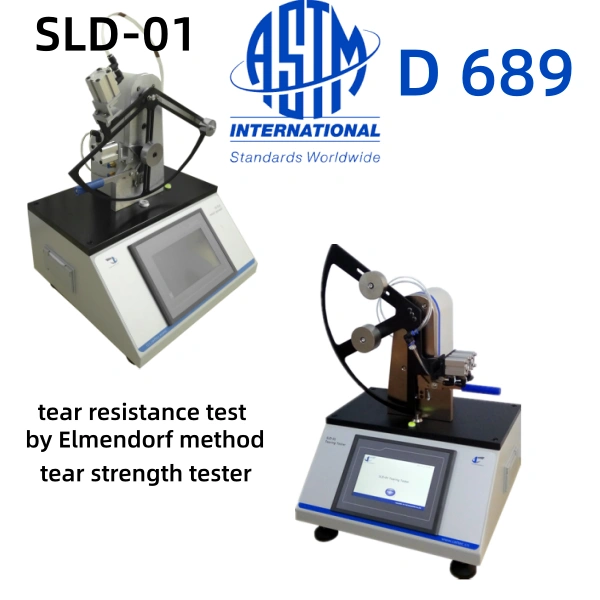
한 Elmendorf-type tearing tester is specifically designed to perform pendulum tear testing according to ASTM requirements.
Typical instrument features include:
- Precision pendulum mechanism
- 공압식 시편 고정
- 자동 진자 해제
- PLC control system
- Touchscreen operation
- 다중 진자 용량
- 자동 통계 계산
- Calibration verification
- Optional data export and reporting software
For laboratories requiring reliable testing across multiple materials, the SLD-01 Tear Tester from Cell Instruments provides an industrial-grade solution suitable for paper, films, flexible laminates, textiles, and nonwoven materials. Its PLC-controlled operation, pneumatic clamping, automatic pendulum release, and optional professional software help improve repeatability while simplifying routine quality control.
Applicable Materials
비록 ASTM D689 primarily focuses on paper products, similar Elmendorf tear principles are widely applied to various flexible materials.
Common testing materials include:
종이
- 인쇄용지
- Copy paper
- 크래프트지
- Tissue paper
- Filter paper
- Specialty paper
Paperboard
- Folding cartons
- Paperboard packaging
- Corrugated liner materials
- Coated boards
유연 포장
- Laminated paper
- Composite packaging
- Paper-foil structures
Industrial Materials
- 라벨
- Release papers
- Industrial wrapping papers
- Technical papers
Typical Testing Procedure
Laboratories generally follow a workflow similar to the following:
- Condition specimens under controlled temperature and humidity.
- Prepare specimens according to standard dimensions.
- Introduce the specified initial slit.
- 적절한 진자 용량을 선택하십시오.
- Mount the specimen securely.
- 진자를 놓아주세요.
- Record tear energy.
- Repeat testing for multiple specimens.
- Calculate the average tear resistance.
- Review statistical consistency and report results.
Maintaining consistent specimen conditioning is particularly important because paper properties are highly sensitive to environmental moisture.
Interpreting ASTM D689 Test Results
Higher tear resistance values generally indicate greater resistance to tear propagation. However, the optimum value depends on the intended application.
예를 들면 다음과 같습니다:
| 신청 | Desired Performance |
|---|---|
| Paper bags | High tear resistance |
| 라벨 | Balanced tear strength |
| 인쇄용지 | Controlled tear propagation |
| 포장지 | Durable handling performance |
| Specialty paper | Application-specific optimization |
When evaluating results, engineers should also consider:
- Basis weight
- Fiber orientation
- Moisture content
- Coating structure
- Manufacturing process
- 인장 강도
- Burst strength
Using multiple mechanical tests together provides a more complete understanding of material performance.
Industries That Benefit from ASTM D689 Testing
Numerous industries rely on ASTM D689 to verify product quality.
패키징
Paper packaging manufacturers evaluate durability before production release.
Paper Mills
Paper producers optimize fiber blends and refining processes.
인쇄
Printers reduce web breaks and improve machine efficiency.
식품 포장
Packaging materials must withstand handling while protecting products.
Medical Packaging
Paper-based sterile barrier systems require controlled mechanical performance.
Research Laboratories
Material scientists compare formulations and manufacturing variables.
Quality Control Advantages
Routine implementation of ASTM D689 provides several operational benefits.
Improved product consistency
Standardized tear testing reduces batch-to-batch variation.
Reduced production waste
Weak material can be identified before downstream processing.
공급업체 자격 심사
Incoming materials can be evaluated against purchasing specifications.
Process optimization
Manufacturers can assess the effects of fiber composition, refining, additives, and coatings.
Regulatory documentation
Standardized testing provides traceable quality records.
ASTM D689 Compared with Related Tear Standards
| 표준 | 재료 | Test Principle |
|---|---|---|
| ASTM D689 | 종이 | Elmendorf pendulum tear |
| ASTM D1922 | 플라스틱 필름 | Elmendorf pendulum tear |
| ISO 6383-1 | 플라스틱 필름 | Pendulum tear method |
| ASTM D1424 | 섬유 | Elmendorf tear method |
| TAPPI T414 | 종이 | 내부 인열 저항 |
Although these standards share similar pendulum principles, specimen dimensions, calculations, and applicable materials differ.
Selecting the appropriate standard depends on the material being tested rather than the testing instrument alone.
Best Practices for Accurate Testing
To obtain reliable ASTM D689 results, laboratories should:
- Condition specimens before testing.
- Use sharp specimen cutting tools.
- Verify pendulum calibration regularly.
- Select the correct pendulum capacity.
- Perform multiple replicate tests.
- Maintain clean specimen clamps.
- Record environmental conditions.
- Follow routine instrument maintenance schedules.
Modern automated Elmendorf-type tearing tester systems further improve reproducibility by minimizing operator influence.
Choosing the Right Tear Testing Solution
~을 선택할 때 Elmendorf-type tearing tester, 연구실에서는 다음 사항을 평가해야 합니다:
- Compliance with ASTM testing requirements
- Available pendulum capacities
- 측정 정확도
- 자동화 수준
- Data management capabilities
- Calibration convenience
- Ease of operation
- Long-term serviceability
For organizations testing paper alongside films, laminates, nonwovens, and flexible packaging materials, selecting a versatile platform such as the Cell Instruments SLD-01 Tear Tester can simplify laboratory operations while supporting multiple international testing standards.
결론
ASTM D689 remains one of the most important standards for evaluating the 종이의 인열 저항. Based on the proven 엘멘도르프 방법, it delivers reliable, repeatable measurements of tear propagation energy that help manufacturers improve product quality, optimize material selection, and maintain consistent production performance.
Whether used for incoming inspection, research and development, process control, or finished product verification, the Elmendorf tear test provides practical insights into paper durability. Combined with a precision Elmendorf-type tearing tester, laboratories can generate dependable data that supports quality assurance across the paper, packaging, printing, and converting industries.