
그리고 ASTM D1424 standard is one of the most widely recognized methods for evaluating the tear strength of fabric using the Elmendorf test. For textile manufacturers, apparel brands, industrial fabric producers, quality laboratories, and research institutions, understanding tear resistance is essential for selecting suitable materials, improving product durability, and ensuring compliance with customer specifications.
Unlike tensile strength, which measures the force required to break an intact specimen, ASTM D1424 evaluates how much force is required to propagate an existing tear. This makes the method particularly valuable because many real-world failures begin with small cuts, punctures, or manufacturing defects that gradually develop into larger tears during use.
This guide explains how ASTM D1424 works, when it should be used, how results are interpreted, and how an Elmendorf tear tester supports reliable quality control in textile production.
What Is ASTM D1424?
ASTM D1424 is the Standard Test Method for determining the tearing strength of fabrics using the falling-pendulum (Elmendorf) apparatus.
The test measures the energy required for a pendulum to continue tearing a pre-cut fabric specimen over a specified distance. The measured energy is then converted into tearing force.
The method is suitable for evaluating numerous textile products, including:
- 직물
- 부직포
- 산업용 섬유
- Coated fabrics
- 기술용 섬유
- 보호복 소재
- Medical textile substrates
- 지반용 직물
Because tearing frequently begins at seams, cuts, needle holes, or accidental damage, ASTM D1424 provides a realistic assessment of fabric durability in practical applications.
Why Is Tear Strength of Fabric Important?
그리고 tear strength of fabric directly influences product service life, user safety, and manufacturing efficiency.
A fabric with excellent tensile strength may still fail prematurely if it exhibits poor tear resistance. Once a small defect forms, insufficient tear resistance allows rapid crack propagation.
Common quality concerns include:
- Garments tearing during repeated use
- Packaging fabrics splitting during transportation
- Medical fabrics damaged during sterilization or handling
- Outdoor textiles exposed to wind loading
- Upholstery fabrics failing under concentrated stress
Testing according to ASTM D1424 helps manufacturers detect these weaknesses before products reach customers.
Understanding the Elmendorf Test Principle
그리고 Elmendorf test is based on energy measurement rather than direct force measurement.
The testing sequence is straightforward:
- A specimen is prepared with a standardized slit.
- The specimen is securely clamped.
- A calibrated pendulum is released.
- The pendulum tears the remaining fabric.
- The energy lost during tearing is measured.
- The instrument converts this energy into tearing force.
Since the pendulum operates under gravity, the measurement is highly repeatable and minimizes operator influence.
This principle has remained the global benchmark for tear resistance testing for decades due to its simplicity, repeatability, and excellent correlation with practical performance.
ASTM D1424 Test Procedure
A typical ASTM D1424 testing workflow includes the following steps.
시료 전처리
Fabric specimens are cut to dimensions specified by the standard.
Each specimen contains a precisely located slit that initiates tearing during testing.
Conditioning specimens under controlled laboratory temperature and humidity is recommended to reduce environmental variation.
Mounting the Sample
The specimen is secured between two clamps on the Elmendorf tear tester.
Proper alignment is essential to ensure accurate tear propagation.
Performing the Test
The pendulum is released automatically.
As it swings downward, it continues tearing the fabric from the pre-cut slit.
The instrument measures the pendulum’s energy loss.
Result Calculation
Modern instruments automatically calculate:
- Average tearing force
- Multiple test statistics
- Standard deviation
- Pass/fail evaluation when required
Digital systems eliminate manual calculations and improve laboratory efficiency.
How to Interpret ASTM D1424 Results
Higher tear values generally indicate greater resistance to tear propagation.
However, acceptable tear strength depends on product application.
| 신청 | Typical Quality Requirement |
|---|---|
| 의류용 원단 | Balance between softness and durability |
| Medical textiles | Resistance during handling and sterilization |
| 산업용 직물 | High tear resistance under repeated loading |
| Outdoor textiles | Excellent tear resistance against wind and abrasion |
| 보호복 | High durability under severe service conditions |
Engineers often compare warp-direction and filling-direction tear values to evaluate fabric balance.
Large differences between directions may indicate anisotropic fabric construction or manufacturing issues.
Factors Affecting Tear Strength of Fabric
Numerous variables influence tear strength of fabric.
섬유 종류
Synthetic fibers generally exhibit higher tear resistance than many natural fibers.
Yarn Structure
Higher yarn strength often improves tearing performance.
원단 구성
Weave pattern significantly affects tear propagation.
For example:
- Plain weave
- Twill weave
- Satin weave
Each produces different tearing characteristics.
Fabric Density
Increasing yarn density does not always increase tear strength.
Excessively tight constructions may actually reduce tearing performance because yarn mobility becomes restricted.
Finishing Processes
Chemical treatments, coatings, resin finishes, and laminations can either improve or reduce tear resistance depending on formulation.
Industries That Rely on ASTM D1424
그리고 ASTM D1424 method supports quality assurance across numerous industries.
These include:
- Textile manufacturing
- Apparel production
- Medical textiles
- Military fabrics
- 지반용 직물
- Automotive interiors
- Furniture upholstery
- 기술용 섬유
- 보호복
- Industrial filtration
- Composite reinforcement fabrics
Many buyers specify minimum tear resistance values as part of product qualification.
ASTM D1424 Compared with Other Tear Test Standards
| 표준 | 시험 방법 | Typical Materials |
|---|---|---|
| ASTM D1424 | Falling Pendulum (Elmendorf) | 원단 |
| ASTM D1922 | Falling Pendulum | 플라스틱 필름 |
| ISO 13937-1 | 엘멘도르프 방법 | 섬유 원단 |
| ISO 6383-2 | 엘멘도르프 방법 | 플라스틱 필름 |
| ASTM D2261 | 혀 눈물 테스트 | 직물 |
| ASTM D5733 | Trapezoid Tear Test | 부직포 |
Each standard addresses different material types and loading conditions. Selecting the correct method depends on product construction and customer specifications.
Selecting an Elmendorf Tear Tester
A modern Elmendorf tear tester should provide:
- 다중 진자 용량
- 자동 진자 해제
- 공압식 시편 고정
- PLC control
- Touchscreen operation
- Automatic statistical analysis
- Calibration verification
- 데이터 내보내기 기능
- Optional printer
- Compliance with multiple ASTM and ISO standards
Instrument repeatability is especially important for laboratories performing routine production testing or third-party certification.
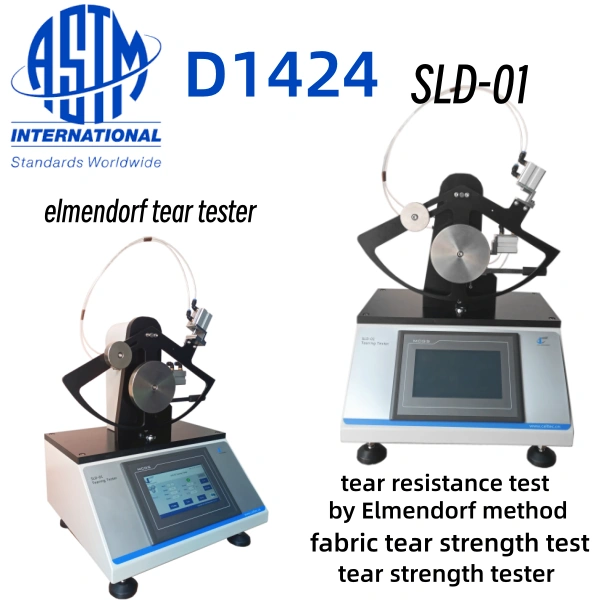
Cell Instruments SLD-01 Tear Tester Solution
For laboratories requiring reliable ASTM D1424 테스트, 그 SLD-01 Tear Tester from Cell Instruments provides an advanced solution for measuring tear resistance across textiles, films, paper, and composite materials.
Key features include:
- Industrial PLC control with intuitive HMI touchscreen
- Automatic pendulum release to reduce operator variability
- 일정한 고정력을 보장하는 공압식 시편 고정 장치
- 다양한 진자 용량: 200, 400, 800, 1600, 3200, and 6400 gf
- Built-in calibration verification using calibration weights
- 자동 통계 계산
- Optional RS-232 communication and micro-printer
- Optional professional software for advanced reporting and traceability
Beyond standard instruments, Cell Instruments also develops customized fixtures, automated testing systems, and integrated material testing solutions for specialized laboratory and production requirements.
Best Practices for Reliable ASTM D1424 Testing
To obtain consistent results:
- Condition specimens before testing.
- Use sharp cutting tools for specimen preparation.
- Verify pendulum calibration regularly.
- 적절한 진자 용량을 선택하십시오.
- Test sufficient specimens for statistical reliability.
- Replace worn clamps when necessary.
- Maintain consistent laboratory temperature and humidity.
- Follow the latest ASTM D1424 specimen preparation requirements.
These practices improve repeatability and reduce measurement uncertainty.
결론
ASTM D1424 remains one of the most trusted standards for evaluating the tear strength of fabric through the proven Elmendorf test. By measuring the energy required to propagate an existing tear, it provides valuable insight into the durability and real-world performance of textile products.
Whether developing apparel fabrics, medical textiles, industrial materials, or technical fabrics, routine ASTM D1424 testing helps manufacturers optimize material selection, improve product reliability, meet customer specifications, and maintain consistent quality. Combined with a high-precision Elmendorf tear tester such as the Cell Instruments SLD-01 Tear Tester, laboratories can achieve accurate, repeatable, and efficient tear resistance testing for both research and production quality control.