
Test Principles Defined in ASTM D624
ASTM D624 describes tear strength as the maximum force required to rupture, initiate, or propagate a tear divided by specimen thickness. During the test, a tensile strength tester applies a constant crosshead speed until the rubber specimen completely tears.
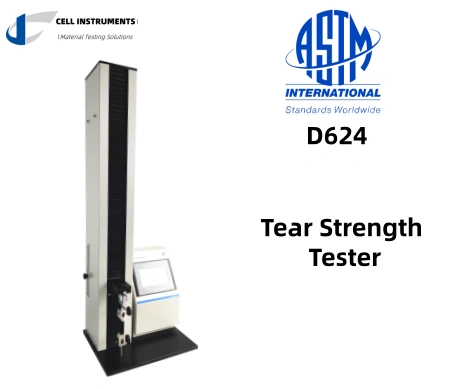
Tear Strength Test for Rubber and Elastomers
A tear resistance test applies controlled tensile deformation to a prepared specimen using a tensile testing machine. The test continues until complete rupture occurs. Because rubber and elastomers exhibit complex deformation behavior, ASTM D624 emphasizes consistent specimen preparation, alignment, and test speed to ensure repeatable results.
It is important to note that rubber and elastomers respond differently to tearing depending on formulation, curing, filler content, and orientation. ASTM D624 therefore defines several specimen types, each designed to represent a different tearing mechanism rather than a single universal value.
Sample Preparation and Test Procedure
Accurate tear resistance testing starts with careful sample preparation. Rubber specimens must have uniform thickness, clean edges, and precise geometry. Any irregularity can significantly influence test results.
Mount the specimen centrally in the grips of a tensile testing machine, ensuring proper alignment to avoid bending or torsional forces. Apply tensile load at the specified constant speed until tearing completes. Record the force-displacement curve and identify peak or average forces according to the selected specimen type.
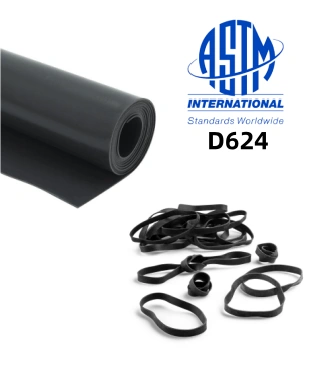
Why Tear Strength Testing Matters in Rubber Applications
In service, rubber products rarely fail due to uniform stretching alone. Instead, failure often begins at sharp edges, embedded particles, or localized stress points. Tear strength testing helps engineers understand how quickly and easily a tear can grow once initiated.
For quality control teams, the tear strength test supports material comparison, process control, and incoming inspection. For product designers, it provides insight into material suitability for demanding applications such as dynamic seals or abrasion-prone environments.