
Plastic films are widely used in packaging, medical devices, agriculture, industrial products, and consumer goods. While tensile strength is often considered an important mechanical property, it does not always predict how a film behaves once a small cut or defect appears. ISO 6383-2 addresses this challenge by specifying a standardized method for measuring the tear resistance test of thin plastic films using the Elmendorf method. The standard helps manufacturers evaluate the tear strength of plastic film, optimize material formulations, and improve product quality consistency.
Whether producing flexible packaging, multilayer barrier films, or medical packaging materials, understanding ISO 6383-2 enables laboratories and quality engineers to obtain repeatable, comparable tear resistance data that supports product development and quality assurance.
What is ISO 6383-2?
ISO 6383-2: Plastics — Film and Sheeting — Determination of Tear Resistance — Part 2: Elmendorf Method specifies a standardized procedure for determining the force required to propagate an existing tear through a plastic film under controlled conditions.
Unlike tensile testing, which measures the force required to stretch or break an intact specimen, ISO 6383-2 evaluates how easily an existing tear continues to propagate. This property is particularly important because many packaging failures originate from small cuts, punctures, or handling damage rather than complete material failure.
The Elmendorf method measures the energy absorbed by a pendulum while tearing a pre-cut specimen over a specified distance. The absorbed energy is converted into tear resistance, typically expressed in Newtons.
Why Tear Resistance Test Matters
A material with excellent tensile strength may still tear easily after being nicked during manufacturing or transportation.
For many flexible packaging applications, tear propagation resistance is a critical performance indicator.
Elmendorf Method Tear Testing Principle of ISO 6383-2
The ISO 6383-2 test is based on the transfer of potential energy stored in a calibrated pendulum.
The testing sequence includes:
- A standard specimen is prepared with a precisely positioned slit.
- The specimen is clamped securely between fixed and movable jaws.
- The pendulum is raised to a specified angle.
- After release, the pendulum tears the specimen.
- The energy consumed during tear propagation is measured.
- The instrument converts the absorbed energy into tear resistance.
Because the tear already exists before testing begins, the measured value represents tear propagation resistance, not tear initiation resistance.
ISO 6383-2 Tear Resistance Test Procedure
The standard specifies several important operational steps to ensure reliable measurements.
Elmendorf Tearing Tester Preparation
Before testing:
- Verify the instrument is level.
- Raise and lock the pendulum.
- Set the indicator to zero.
- Confirm calibration accuracy.
- Select the appropriate pendulum capacity.
The selected pendulum should produce readings between approximately 20% and 80% of its full-scale capacity for optimal measurement accuracy.
Specimen Preparation
Test specimens require:
- Standard dimensions
- Precisely cut slit
- Smooth edges
- No visible defects
- Conditioning according to laboratory procedures
Both machine direction (MD) and transverse direction (TD) specimens are normally tested because film properties are often anisotropic.
Conducting the Test
Each specimen is:
- Positioned carefully between the clamps
- Aligned with the slit centered
- Firmly clamped
- Torn by releasing the pendulum
- Recorded individually
If the tear deviates excessively from the intended path, the result should be rejected according to the requirements of ISO 6383-2.
ISO 6383-2 Compared with Other Tear Test Standards
| Standard | Test Method | Primary Materials |
|---|---|---|
| ISO 6383-2 | Elmendorf pendulum | Plastic films and sheeting |
| ASTM D1922 | Elmendorf pendulum | Plastic film |
| ASTM D1424 | Elmendorf pendulum | Textile fabrics |
| ISO 1974 | Elmendorf method | Paper and paperboard |
Although these standards employ similar pendulum principles, specimen preparation, calculation methods, and intended materials differ significantly.
Selecting an Elmendorf Tearing Tester
When choosing an Elmendorf tearing tester, laboratories should consider several technical factors beyond compliance with ISO 6383-2:
- Wide measurement range for different film strengths
- Automatic pendulum release to minimize operator influence
- Stable specimen clamping
- Simple calibration procedures
- Statistical analysis functions
- Data export capabilities
- Compliance with multiple international standards
- Easy operation for routine quality control
Modern laboratories increasingly prefer digital instruments that improve repeatability while simplifying data management.
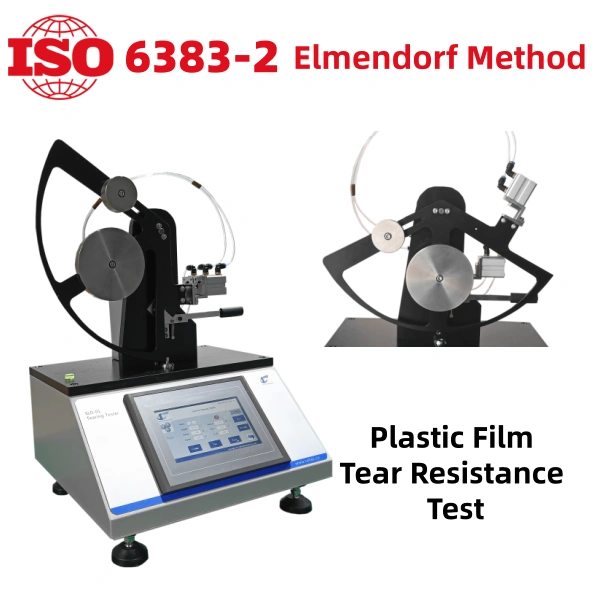
Cell Instruments SLD-01 Elmendorf Tearing Tester
For laboratories performing ISO 6383-2 testing on plastic films and flexible materials, the SLD-01 Elmendorf Tearing Tester from Cell Instruments provides a practical solution designed for routine quality control and research applications.
Key technical features include:
- PLC control with HMI touchscreen for intuitive operation
- Pneumatic specimen clamping to ensure consistent gripping force
- Automatic pendulum release to reduce operator variability
- Integrated calibration weight for convenient accuracy verification
- Automatic statistical calculations for efficient result analysis
- Optional professional software for advanced reporting and data management
- Optional micro-printer and RS-232 interface for traceability
- Multiple pendulum capacities from 200 gf to 6400 gf, supporting a wide range of film materials
These capabilities help laboratories achieve repeatable measurements while improving testing efficiency and documentation.
ISO 6383-2 provides a reliable and internationally recognized approach for evaluating the tear resistance test performance of flexible plastic films using the Elmendorf method. By measuring the energy required to propagate a controlled tear, the standard delivers valuable information for material development, process optimization, and quality control.
For manufacturers of packaging films, medical materials, agricultural films, and other flexible plastics, incorporating ISO 6383-2 into routine testing programs helps improve product consistency, reduce failure risks, and support compliance with customer and industry requirements. Combined with a high-quality Elmendorf tearing tester, laboratories can generate accurate, repeatable data that contributes to better material selection and long-term product reliability.