
Fabric tear resistance is a critical performance property for textiles used in apparel, industrial fabrics, technical textiles, protective clothing, packaging textiles, and nonwoven products. ISO 13937-1 provides a standardized method for evaluating the force required to propagate a pre-cut tear in a fabric using the ballistic pendulum method, commonly known as the Elmendorf tear strength test.
For manufacturers, laboratories, and quality control professionals, understanding ISO 13937-1 helps ensure that textile products can withstand real-world stresses encountered during handling, processing, transportation, and end-use applications. This article explains the testing principle, procedure, applications, result interpretation, and equipment requirements associated with the tear test of fabric according to ISO 13937-1.
Understanding ISO 13937-1
ISO 13937-1: Textiles — Tear Properties of Fabrics — Part 1: Determination of Tear Force Using Ballistic Pendulum Method (Elmendorf) specifies a method for measuring the force required to continue a tear that has already been initiated in a fabric specimen.
Unlike tensile testing, which measures the force required to break an entire specimen, ISO 13937-1 focuses on tear propagation. This distinction is important because fabrics in practical applications often fail from existing cuts, punctures, or defects rather than from uniform tensile loading.
The method is primarily applicable to:
- Woven fabrics
- Many nonwoven materials
- Coated textiles
- Technical textiles
- Industrial fabrics
The standard is generally not suitable for:
- Knitted fabrics
- Highly elastic woven fabrics
- Extremely loose constructions
- Highly anisotropic fabrics where tear direction may deviate during testing
Why Is Tear Strength Important?
Tear resistance is often a key indicator of fabric durability and service life.
Common Quality Concerns Addressed by Tear Testing
| Application | Importance of Tear Strength |
|---|---|
| Apparel fabrics | Resistance to accidental tearing during wear |
| Protective clothing | Prevention of tear propagation after damage |
| Geotextiles | Durability under installation stress |
| Industrial textiles | Performance under mechanical loading |
| Nonwoven materials | Structural integrity during handling |
| Upholstery fabrics | Resistance to damage during use |
A fabric may exhibit excellent tensile strength yet fail prematurely if its tear resistance is inadequate. Therefore, the tear test of fabric provides complementary information that is essential for comprehensive material evaluation.
Elmendorf Tear Strength Testing Principle
The Elmendorf tear strength method measures the energy required to propagate a tear through a specified distance in a fabric specimen.
How the Test Works
A rectangular specimen is secured between two clamps:
- One clamp is fixed
- The other is attached to a pendulum
A pre-cut slit is introduced into the specimen.
When the pendulum is released:
- Potential energy is converted into kinetic energy.
- The moving clamp rapidly pulls the fabric.
- The tear propagates through a defined distance.
- The energy absorbed during tearing is measured.
- The corresponding tear force is calculated and reported.
The test quantifies the average force required to continue tearing the material.
Visualization of the Test Process
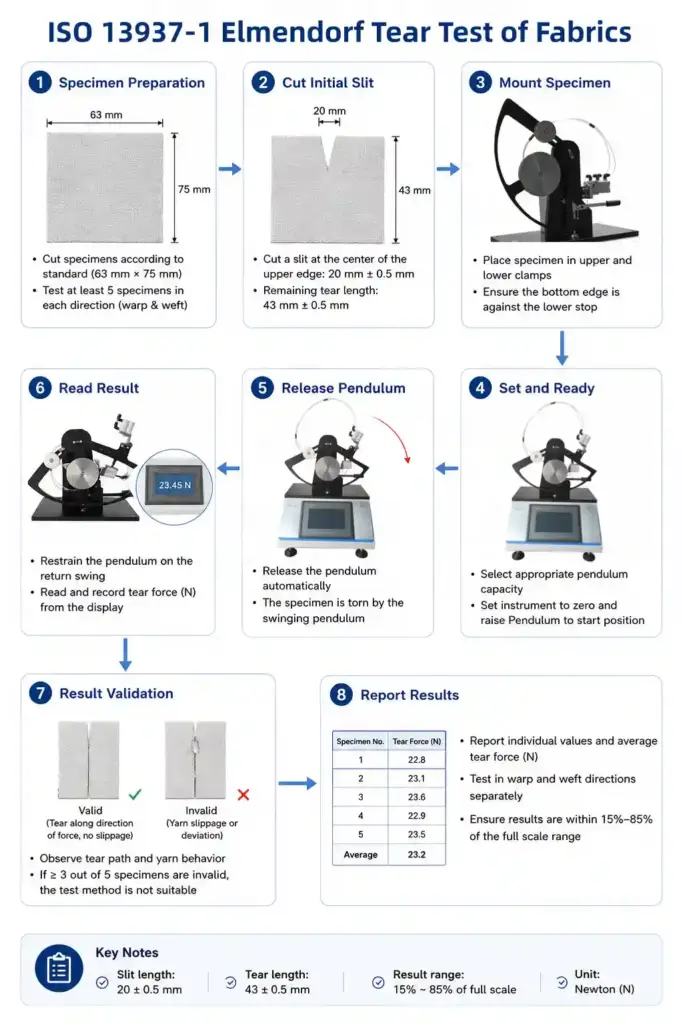
Specimen Preparation → Pre-cut Slit → Clamp Specimen → Release Pendulum → Tear Propagation → Force Calculation
This rapid loading condition simulates situations where tearing occurs suddenly during actual use.
ISO 13937-1 Test Procedure
1. Specimen Preparation
The specimen dimensions and orientation must comply with the standard requirements.
Testing is typically performed in both:
- Warp direction
- Weft direction
Multiple specimens are prepared to ensure statistical reliability.
3. Performing the Test
The specimen is mounted carefully between the clamps.
The operator:
- Raises the pendulum to its starting position
- Verifies zero calibration
- Releases the pendulum
- Records the measured tear force
The selected pendulum capacity should generate readings between: 15% and 85% of full-scale capacity to achieve optimal accuracy.
2. Creating the Initial Cut
A slit measuring:
20 mm ± 0.5 mm
is cut into the specimen before testing.
The remaining tear path is:
43 mm ± 0.5 mm
This controlled geometry ensures consistency between laboratories.
4. Validity Checks
The tear should:
- Follow the intended tear direction
- Remain stable throughout propagation
- Not exhibit excessive yarn slippage
Results must be rejected if thread slippage occurs instead of actual tearing. If three or more specimens out of five are invalid, the method may not be suitable for that material.
Key Factors Affecting Elmendorf Tear Strength
Several material characteristics influence test results.
Fabric Construction
- Yarn count
- Fabric density
- Weave pattern
- Yarn interlacing frequency
Generally, tighter constructions exhibit different tear behavior than loose constructions.
Fiber Type
Examples include:
- Cotton
- Polyester
- Nylon
- Aramid
- Polypropylene
- Blended fibers
Fiber strength and elongation properties directly affect tear propagation.
Finishing Treatments
Chemical and mechanical finishing processes can significantly influence tear performance:
- Coatings
- Resin treatments
- Waterproof finishes
- Flame-retardant treatments
Fabric Direction
Warp and weft tear strengths often differ substantially due to construction differences.
For this reason, ISO 13937-1 requires testing in each relevant direction.
Interpreting Test Results
The primary reported value is tear force, typically expressed in:
Newtons (N)
Higher values generally indicate greater resistance to tear propagation.
Example Data
| Sample | Warp Tear Force (N) | Weft Tear Force (N) |
|---|---|---|
| Fabric A | 28.5 | 24.8 |
| Fabric B | 42.1 | 38.7 |
| Fabric C | 15.6 | 18.2 |
These values may be used for:
- Product development
- Supplier qualification
- Incoming material inspection
- Production quality control
- Competitive benchmarking
Applications of ISO 13937-1 Across Industries
Textile Manufacturing
Manufacturers use ISO 13937-1 to verify durability requirements and maintain product consistency.
Protective Clothing
Protective garments require adequate tear resistance to maintain safety after minor damage occurs.
Technical Textiles
Industrial fabrics used in transportation, construction, and filtration applications frequently require tear performance verification.
Nonwoven Products
Many nonwoven materials used in hygiene, medical, and industrial sectors are evaluated using the Elmendorf tear strength method.
Research and Development
Material developers use the standard to compare new fabric constructions, fibers, and finishing technologies.
Elmendorf Tearing Tester Requirements
An Elmendorf tearing tester must provide:
- Accurate pendulum energy measurement
- Stable clamping conditions
- Controlled specimen positioning
- Reliable calibration capability
- Repeatable pendulum release
Because tear force can be highly sensitive to testing conditions, equipment quality plays a significant role in achieving repeatable and reproducible results.
Cell Instruments SLD-01 Elmendorf Tearing Tester
For laboratories performing ISO 13937-1 testing, the SLD-01 Elmendorf Tearing Tester from Cell Instruments is designed to support standardized tear resistance evaluation of textiles, paper, films, nonwovens, and related materials.
Key Features
- PLC-controlled system with touchscreen HMI
- Pneumatic specimen clamping for consistent gripping force
- Automatic pendulum release to reduce operator influence
- Multiple pendulum capacities:
- 200 gf
- 400 gf
- 800 gf
- 1600 gf
- 3200 gf
- 6400 gf
- Built-in calibration weight verification
- Automated statistical calculations
- Optional professional software for data management
- Optional micro-printer and RS-232 connectivity
Technical Specifications
| Parameter | Specification |
|---|---|
| Pendulum Capacity | 200–6400 gf |
| Tearing Arm Length | 104 ± 1 mm |
| Initial Tearing Angle | 27.5° ± 0.5° |
| Gas Supply | 0.6 MPa |
| Power Supply | AC 110–220 V, 50/60 Hz |
The system supports laboratories seeking reliable compliance with ISO 13937-1 and other tear resistance testing requirements.
Related Tear Testing Standards
Although ISO 13937-1 is widely used, other tear testing methods may be applicable depending on the material type and industry requirements.
| Standard | Method |
|---|---|
| ISO 13937-1 | Elmendorf pendulum method |
| ISO 13937-2 | Single tear method |
| ISO 13937-3 | Trouser tear method |
| ISO 13937-4 | Tongue tear method |
| ASTM D1424 | Elmendorf tear method for textiles |
| ASTM D5734 | Trouser tear method |
| TAPPI T414 | Elmendorf tear resistance for paper |
Selecting the appropriate method depends on fabric construction, application requirements, and customer specifications.
ISO 13937-1 remains one of the most widely recognized standards for evaluating tear propagation resistance in woven fabrics and many nonwoven materials. By measuring Elmendorf tear strength, manufacturers and testing laboratories can better understand fabric durability, compare material performance, and ensure compliance with customer and industry requirements.
A properly executed tear test of fabric provides valuable quality control data that supports product development, supplier qualification, and ongoing manufacturing consistency. When combined with a high-quality Elmendorf tearing tester, the method delivers reliable and repeatable results that help maintain textile performance throughout the product lifecycle.